
02 — AI TRAVEL PLANNING — TEAM PROJECT — 2025
Trip Terminal
From travel inspiration to an actionable plan — enabling AI to truly support users through a full journey, not just generate a guide.
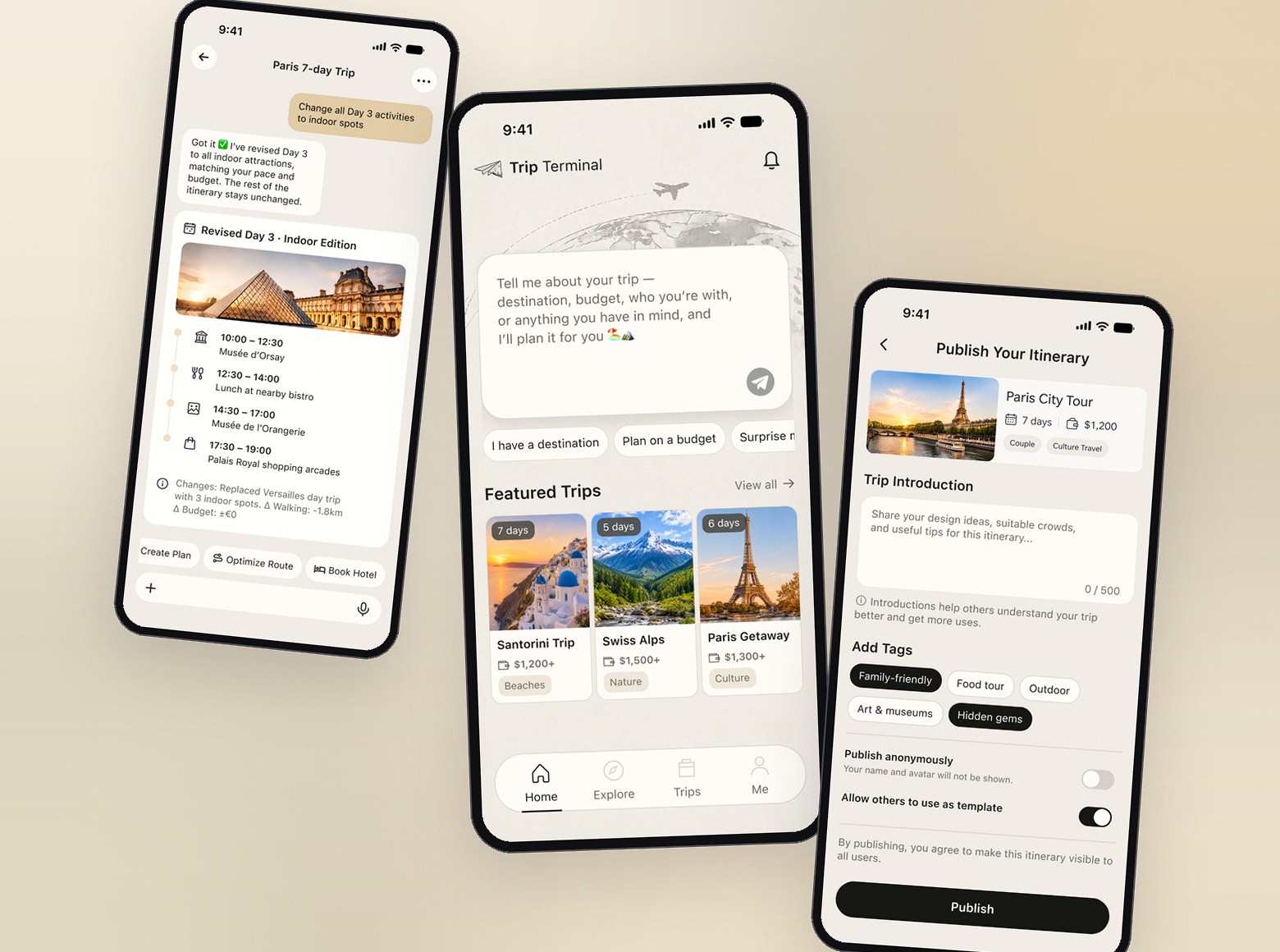
AT A GLANCE
Beyond generating travel guides — an AI platform that turns the cumbersome, fragmented planning process into a personalized, trustworthy, actionable journey.
01 — PROJECT ORIGIN
Born from our own messy trip planning
A sophomore team project for the university's Three Innovation Competition. Most of us love travelling, yet putting together a complete guide means collecting scattered information across platforms, comparing distances, opening hours and budgets, and reconciling everyone's needs. As generative AI took off, we asked — what if users could simply tell AI where, with whom and on what budget, and receive a plan truly tailored to them?
02 — MARKET RESEARCH
A large market, a fragmented toolchain
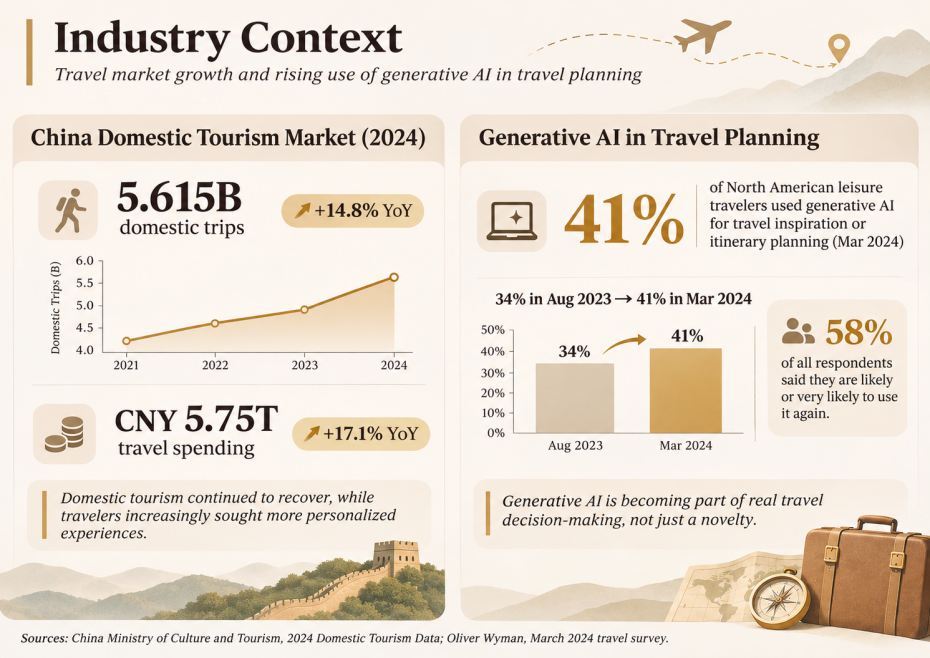
2.1 — INDUSTRY BACKGROUNDPer the Ministry of Culture & Tourism, domestic trips reached 5.615 billion in 2024 (+14.8% YoY), with spending of ¥5.75 trillion (+17.1%). An Oliver Wyman survey shows 41% of respondents had already used generative AI for travel inspiration or planning.
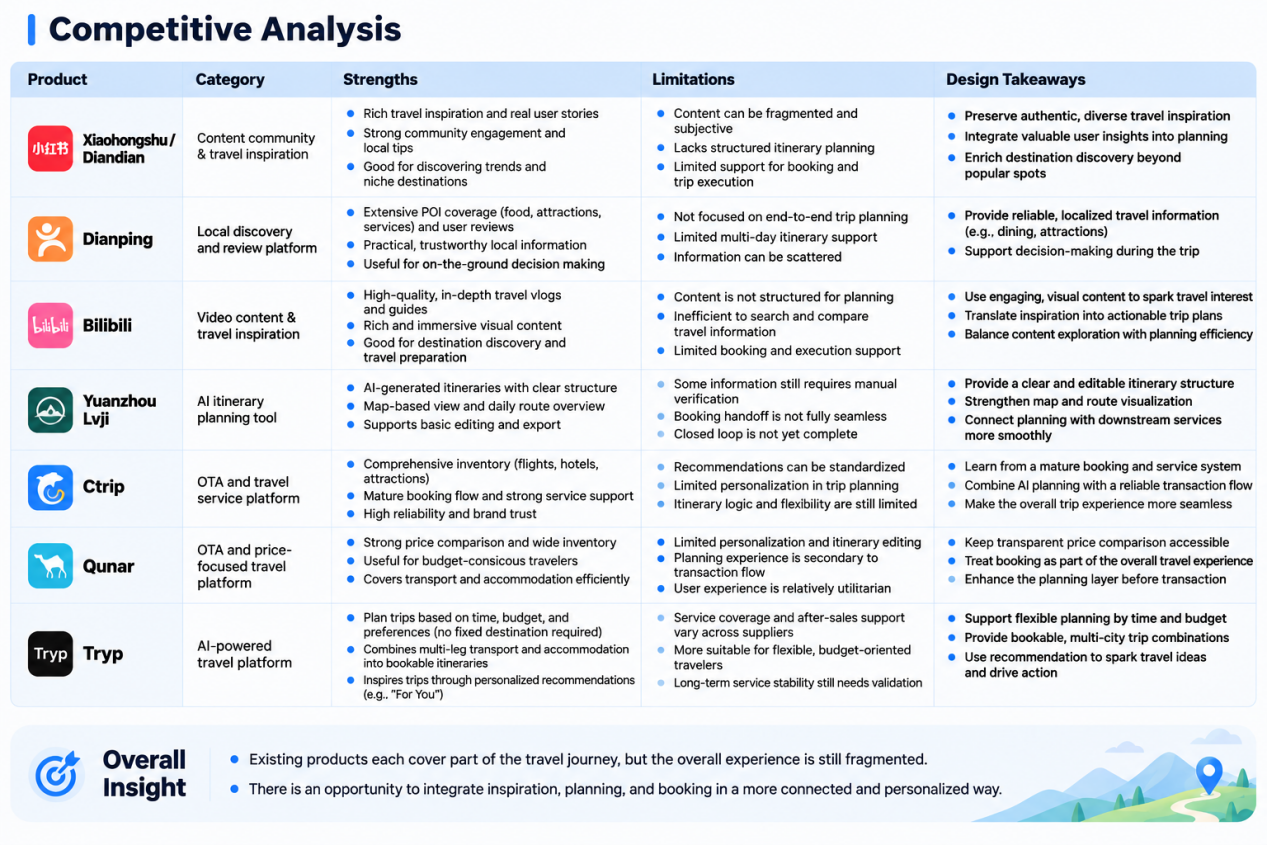
What users need is not another guide generator, but a continuous experience that completes planning step by step.
03 — USER RESEARCH
Listening to real travel planning
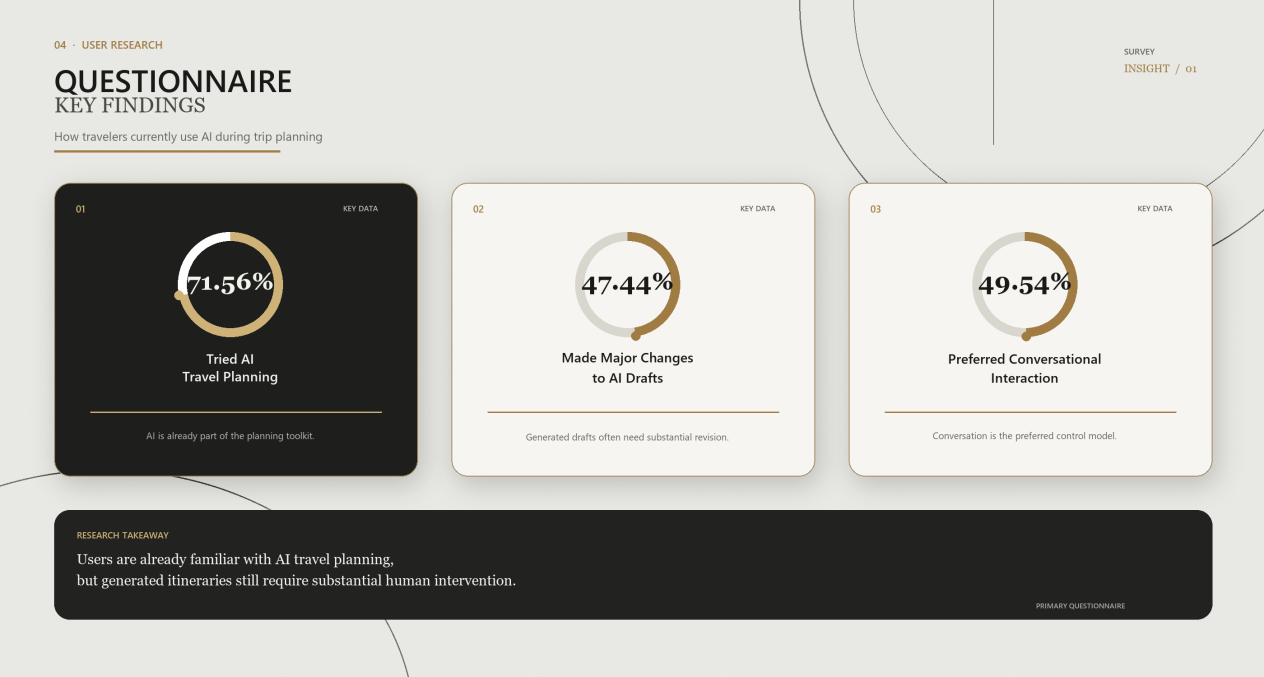
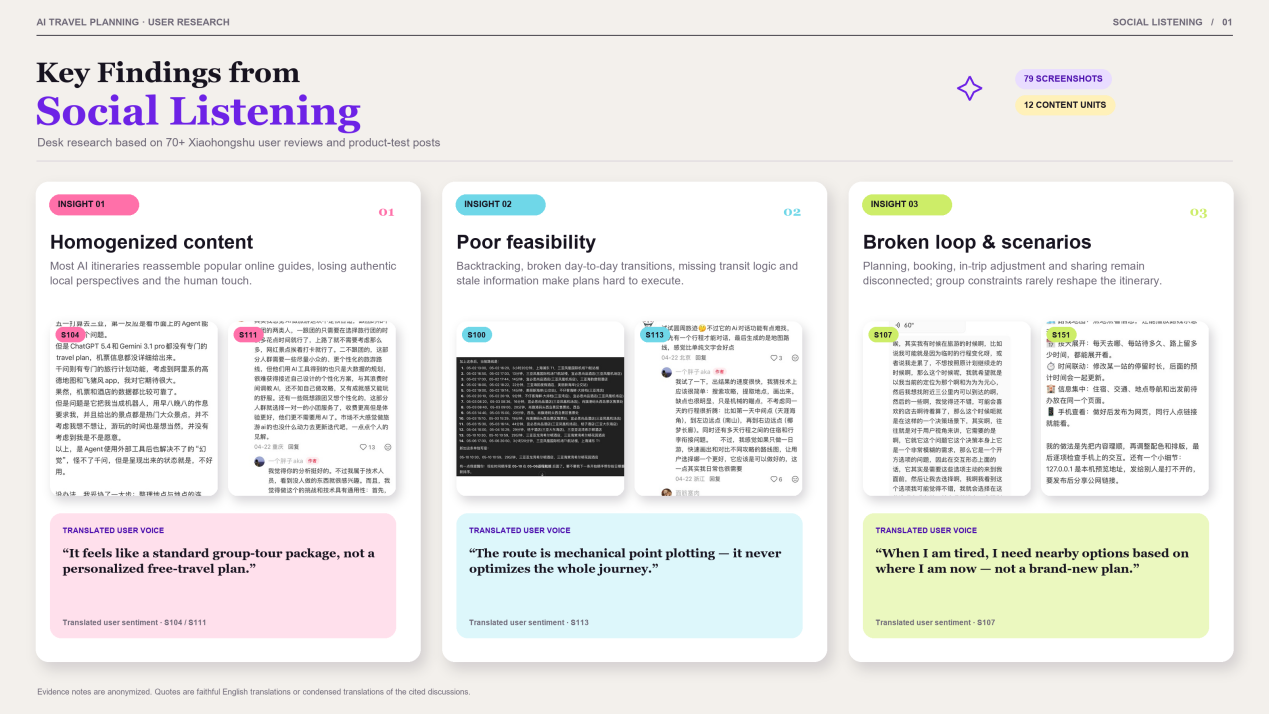
Social listening — beyond preset options
We collected posts, tool reviews and comment threads about AI travel planning on Xiaohongshu — what people actually use, where it breaks, and what they wish existed.
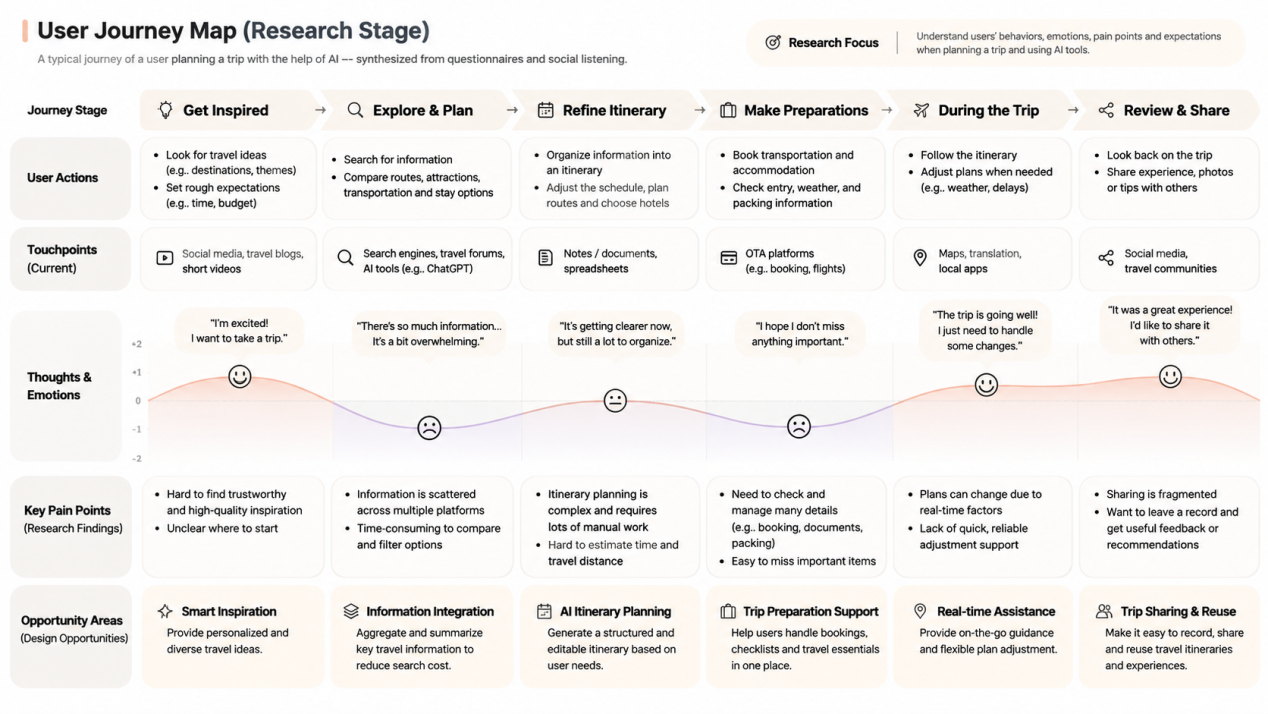
A six-stage journey map
Users' difficulties are not concentrated in a single link — they run through the entire journey, from getting inspired to reviewing and sharing afterwards.
Insight 01 — Content homogenization. AI struggles to understand real preferences and patchworks popular guides instead.
Insight 02 — Low practical feasibility. Accuracy, route logic, transport connections and pacing all suffer in generated plans.
Insight 03 — A fragmented journey. Modification, booking and preparation still mean switching between platforms.
04 — PAIN POINT SORTING
Two layers of problems, one core pool
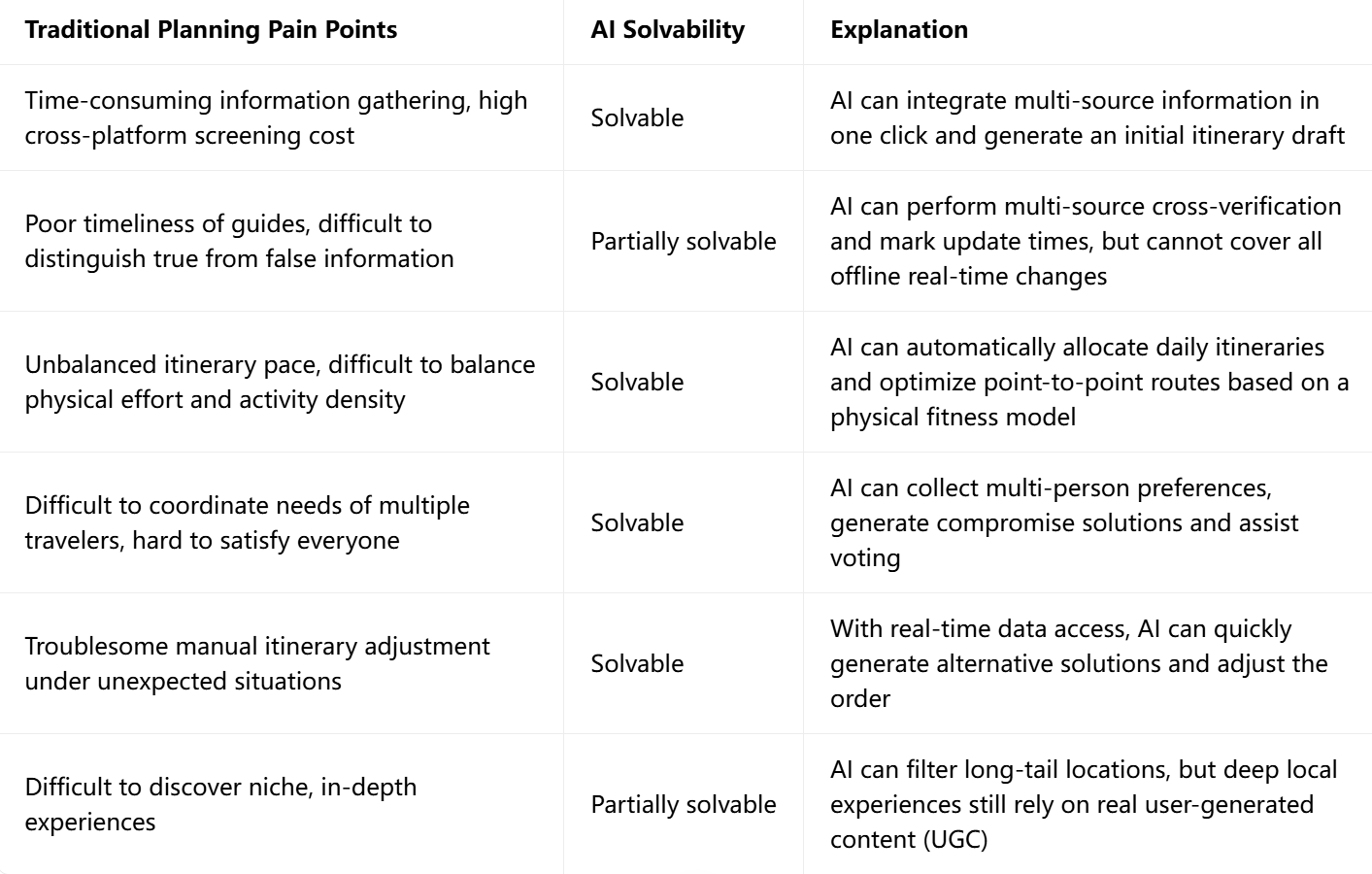
Layer one maps traditional manual-planning pains by whether AI can solve them. Layer two lists what AI tools themselves get wrong — generic customization, stale information, weak executability, no closed loop, token multi-person support, and no inspiration stage.
01 — Itineraries don't adapt to different groups and route preferences.
02 — Information accuracy and timeliness fail users in the field.
03 — Route movement and pacing are often unreasonable.
04 — Planning, booking and execution don't connect.
05 — Modification is inflexible and slow.
06 — Multi-person and special scenarios get only token support.
07 — No pre-trip discovery stage; the anticipation of travel is lost.
05 — PRODUCT DEFINITION
Every feature answers a pain point
Solutions came from survey expectations, social-listening feedback, competitor references and team brainstorming — then matched one by one to the problem pool, so nothing is stacked without a demand behind it.
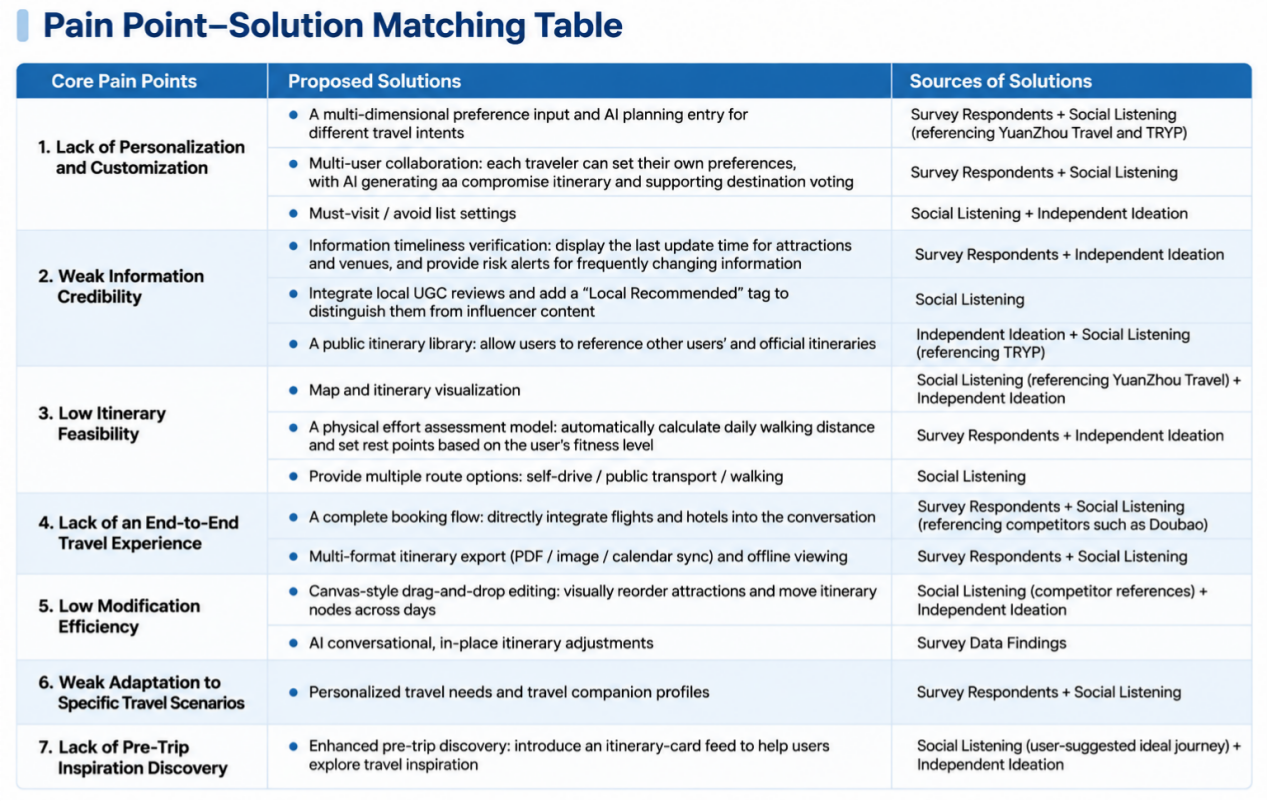
Module 01 — Pre-Trip Discovery. Inspiration card feed.
Module 02 — AI Generation & Feasibility. Preference input, must-visit / avoid, map visualization, stamina assessment, multi-modal routes, companion profiles, collaborative planning.
Module 03 — Editing & Interaction. Canvas drag-and-drop, AI conversational editing.
Module 04 — Credibility & Community. Freshness verification, local UGC reviews, public itinerary library.
Module 05 — End-to-End Support. Integrated booking flow, multi-format export & sync.
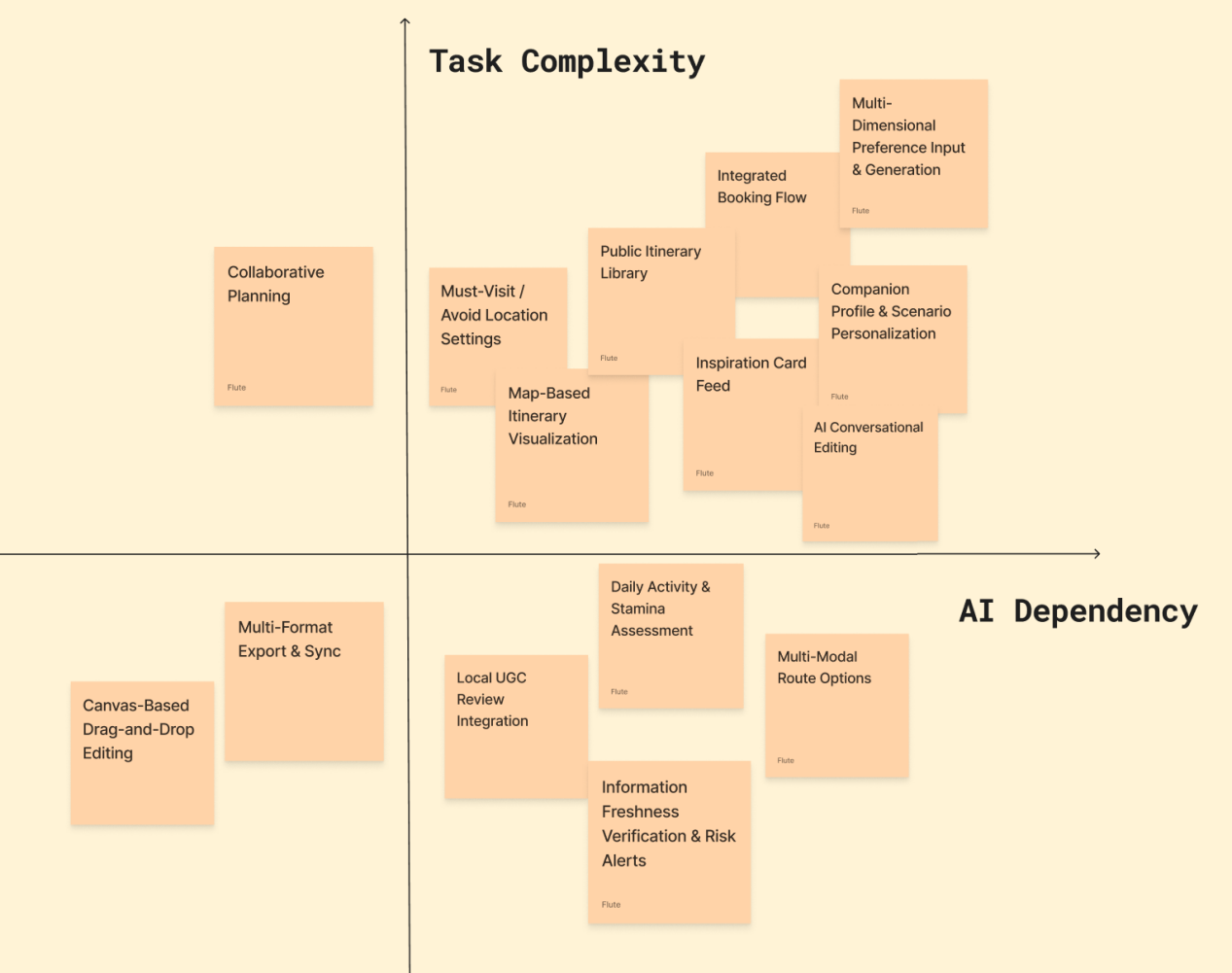
5.3 — PRIORITIZATION: TASK COMPLEXITY × AI DEPENDENCY
P0 — Core experience: inspiration feed, preference input, must-visit / avoid, map itinerary, companion profiles, conversational editing, public library, integrated booking.
P1 — Supporting: stamina assessment, multi-modal routes, freshness verification, UGC integration, collaboration.
P2 — Future: canvas editing, export & sync.
06 — DESIGN PROCESS
From AI exploration to a paper airplane
6.1 — AI-assisted exploration, then human judgment
Three sets of AI-generated concept UIs explored layouts and visual directions quickly — but showed flow inconsistency, generic templating and weak alignment with our research. Instead of adopting them, I re-screened the direction against the findings.
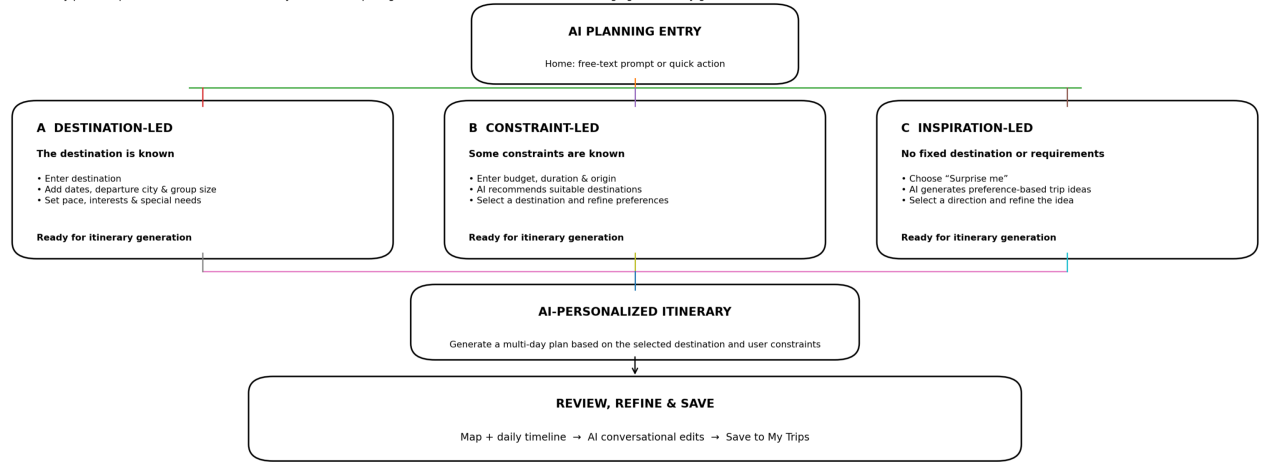
6.2 — Four wireflows, three planning entries
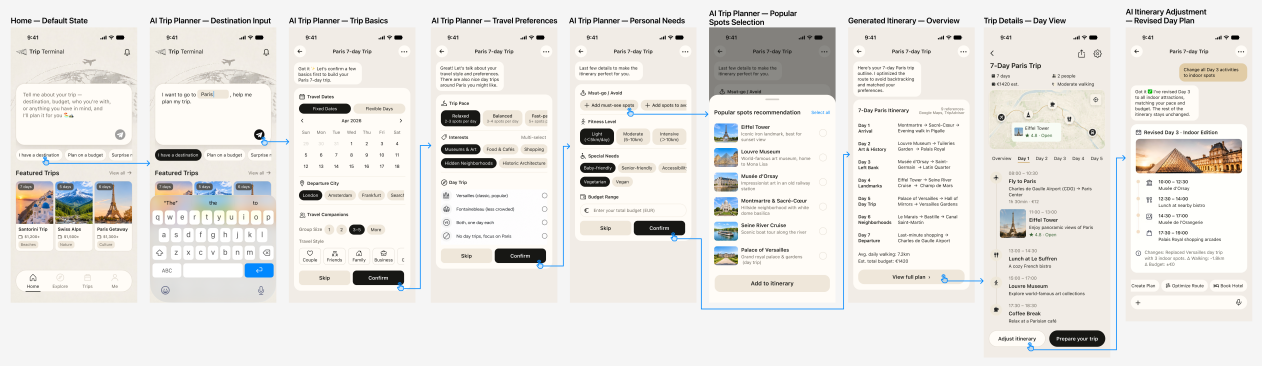
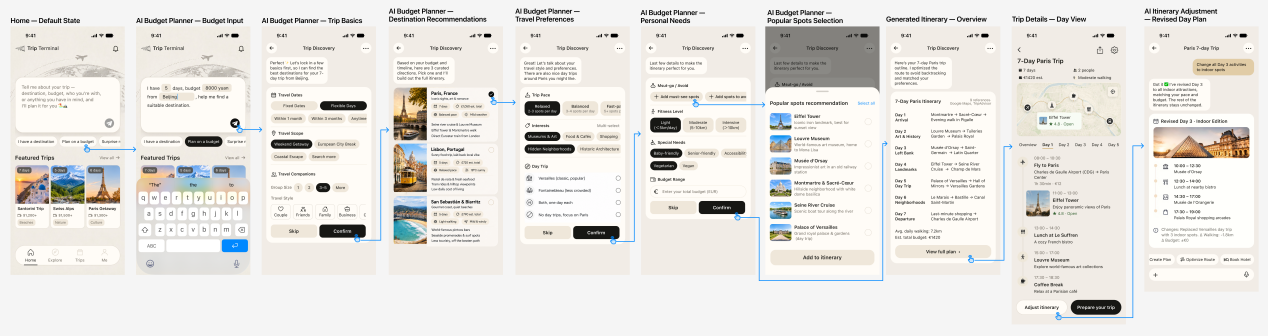
The end-to-end journey — discover, plan, refine, prepare, share — splits into four task closed loops. Itinerary generation offers three entries by information completeness, converging into one itinerary experience.
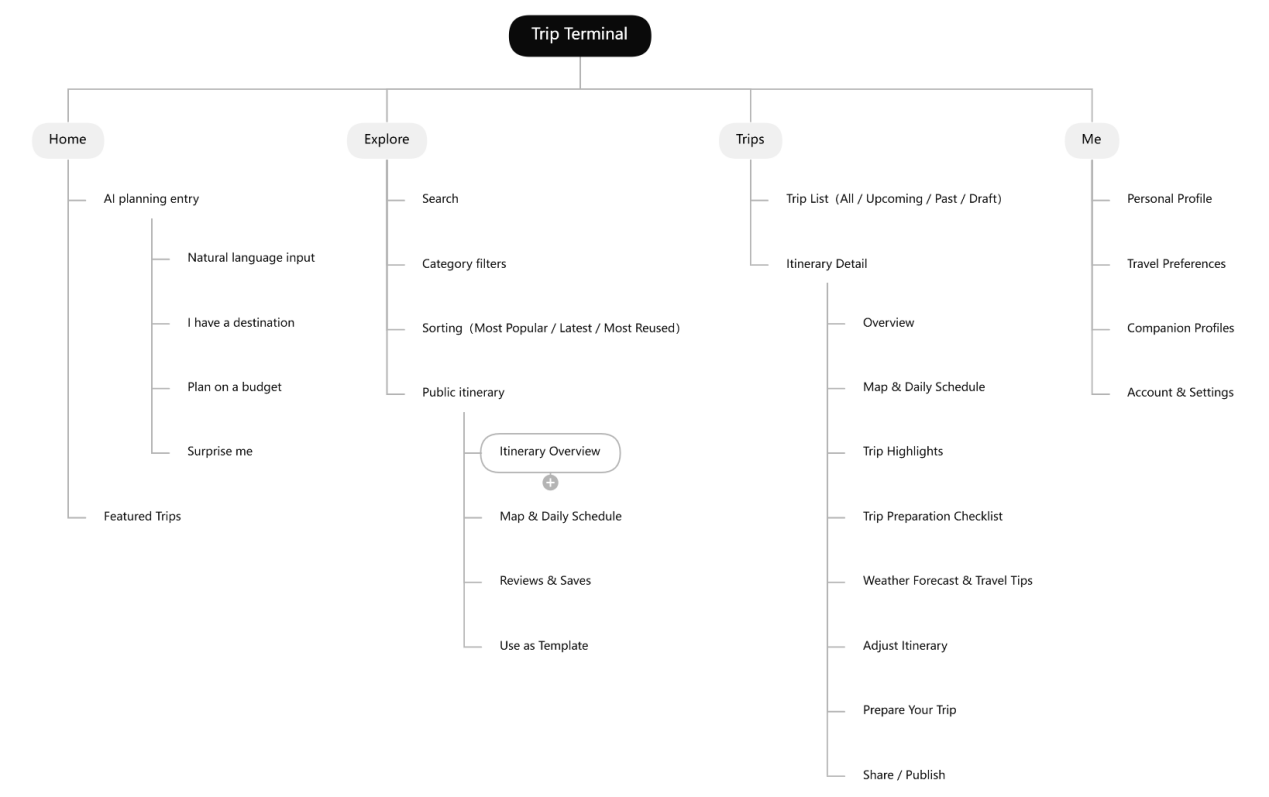
6.3 — Information architecture
AI planning is a through-line service, not a bottom tab. Plans start from Home or from any public itinerary via "Use as template" — and all of them land in Trips.
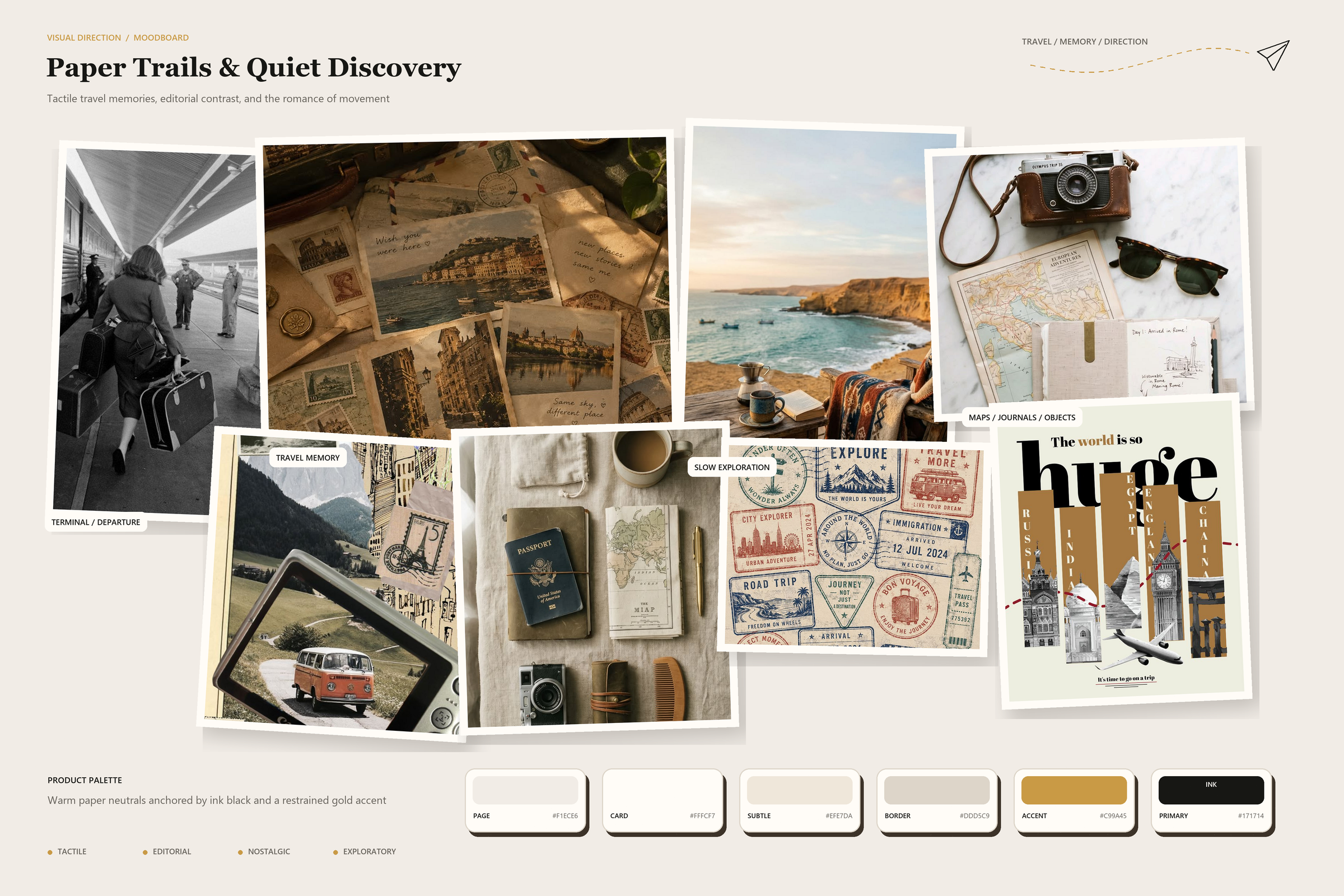
6.4 — Visual style, from a paper airplane
Terminal is the starting point of a journey; the paper airplane turns an idea into a real trip. Paper, maps, stamps and travel journals become warm white, light beige, golden brown and ink — a deliberate departure from the blue-green sameness of travel apps.
6.5 — UI style guide
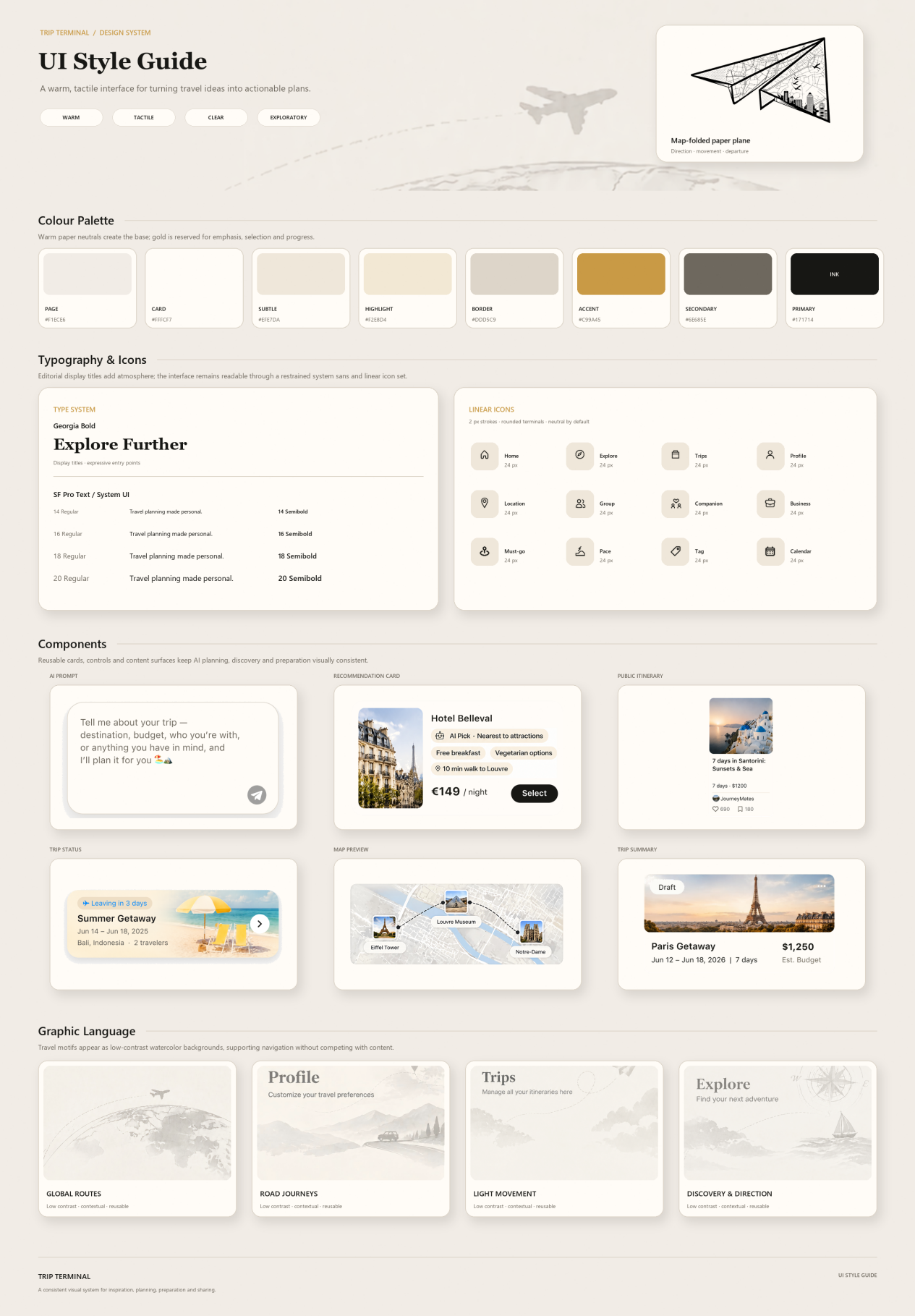
Abstract feelings turned into reusable rules — warm paper tones with clear modern typography and one component system spanning AI planning, exploration, preparation and sharing. The goal is not retro imitation, but warmth with the efficiency a digital tool requires.
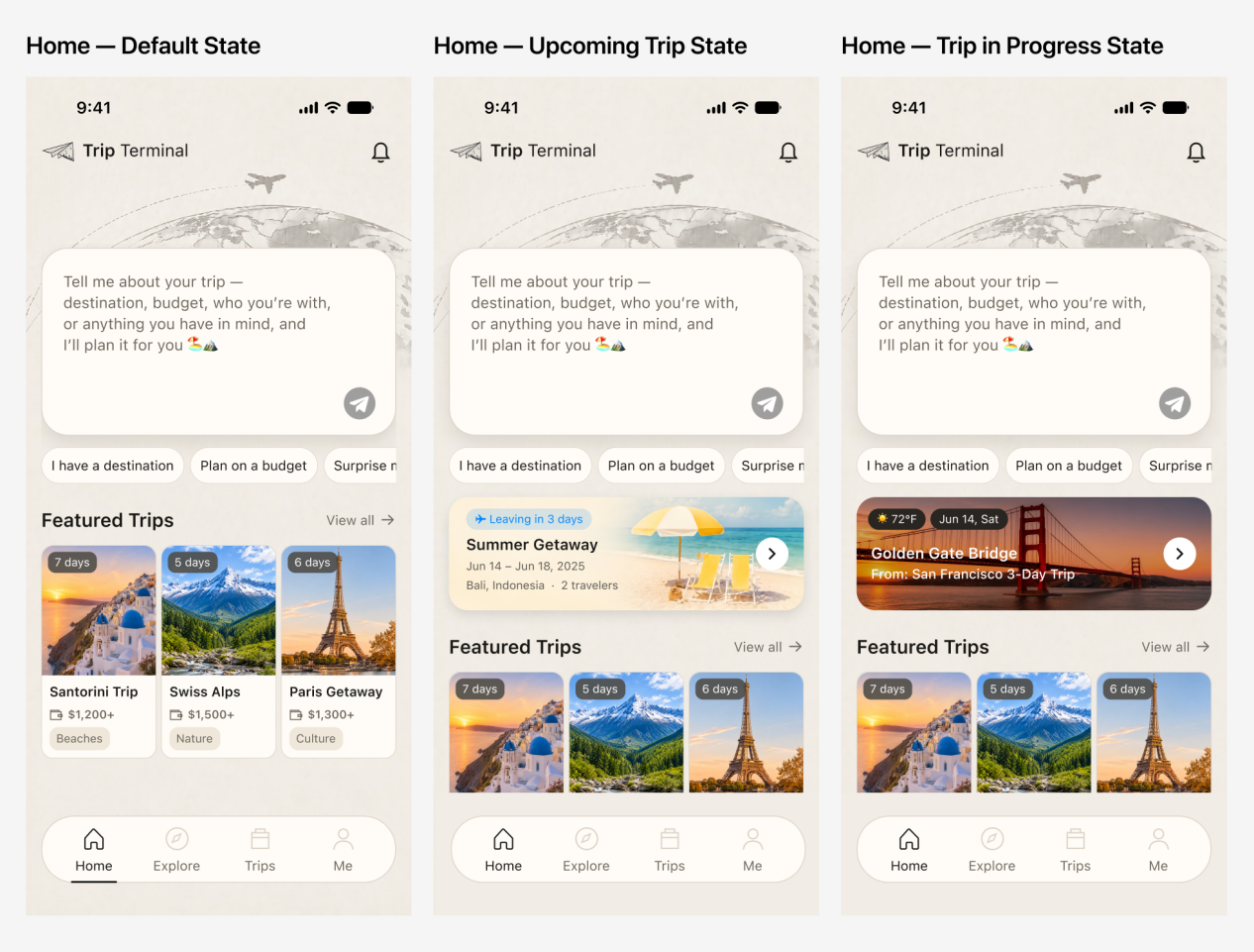
6.6 — A home that knows your travel state
Default state centers AI input and three quick entries; an upcoming trip adds a countdown card; a trip in progress surfaces weather and a quick return to the itinerary.
07 — FINAL DESIGN
Four flows, from inspiration to publish
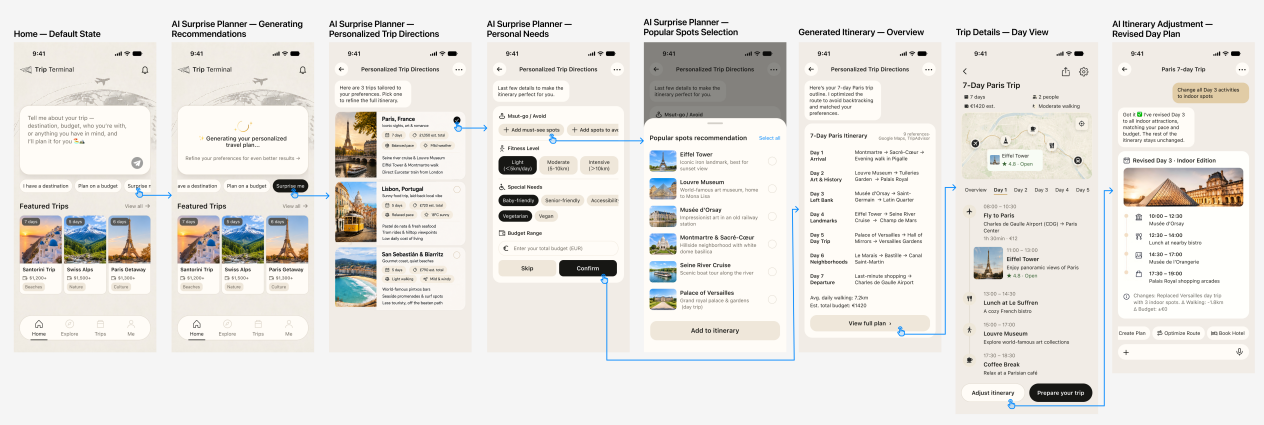
FLOW 01 — AI ITINERARY GENERATIONThree entries converge into one itinerary experience — AI drafts day-by-day plans with budget and walking intensity, and natural language keeps refining them with transparent change summaries.
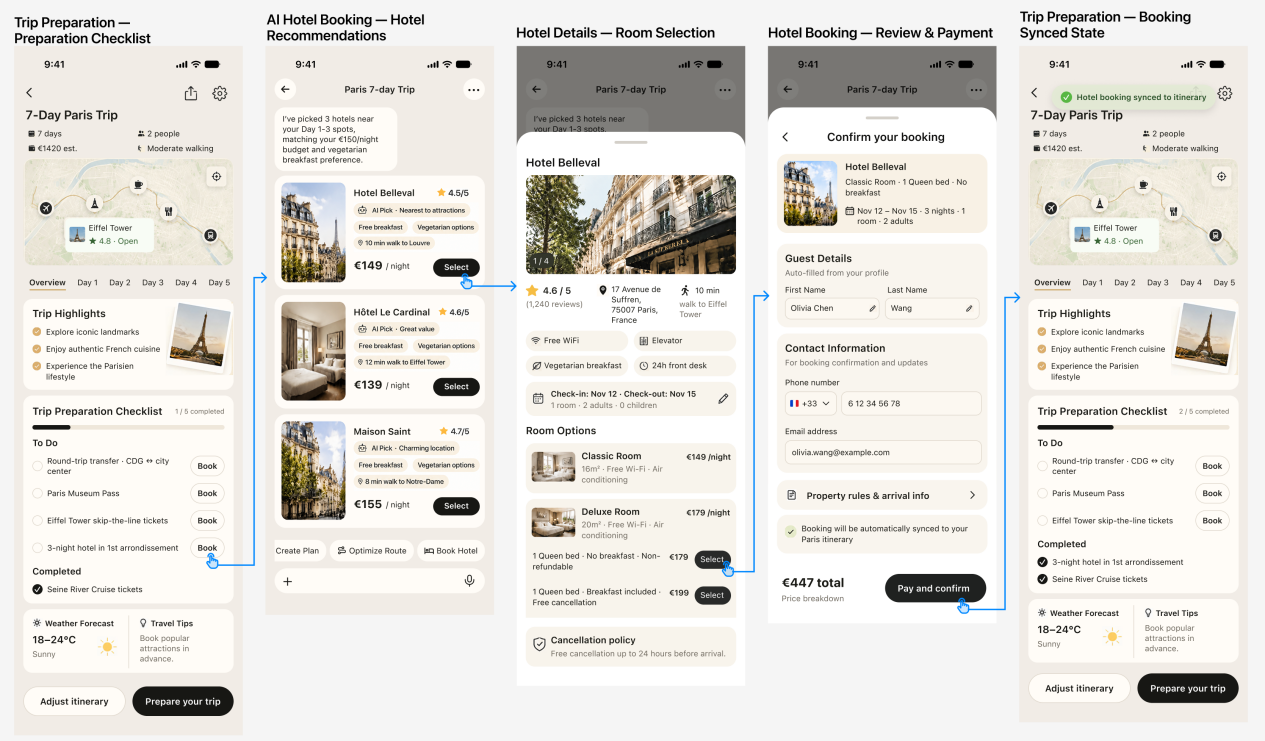
FLOW 02 — PLAN TO ACTIONA preparation checklist, hotel recommendations matched to the itinerary and budget, bookings synced back automatically — and one-tap replanning when the weather turns.
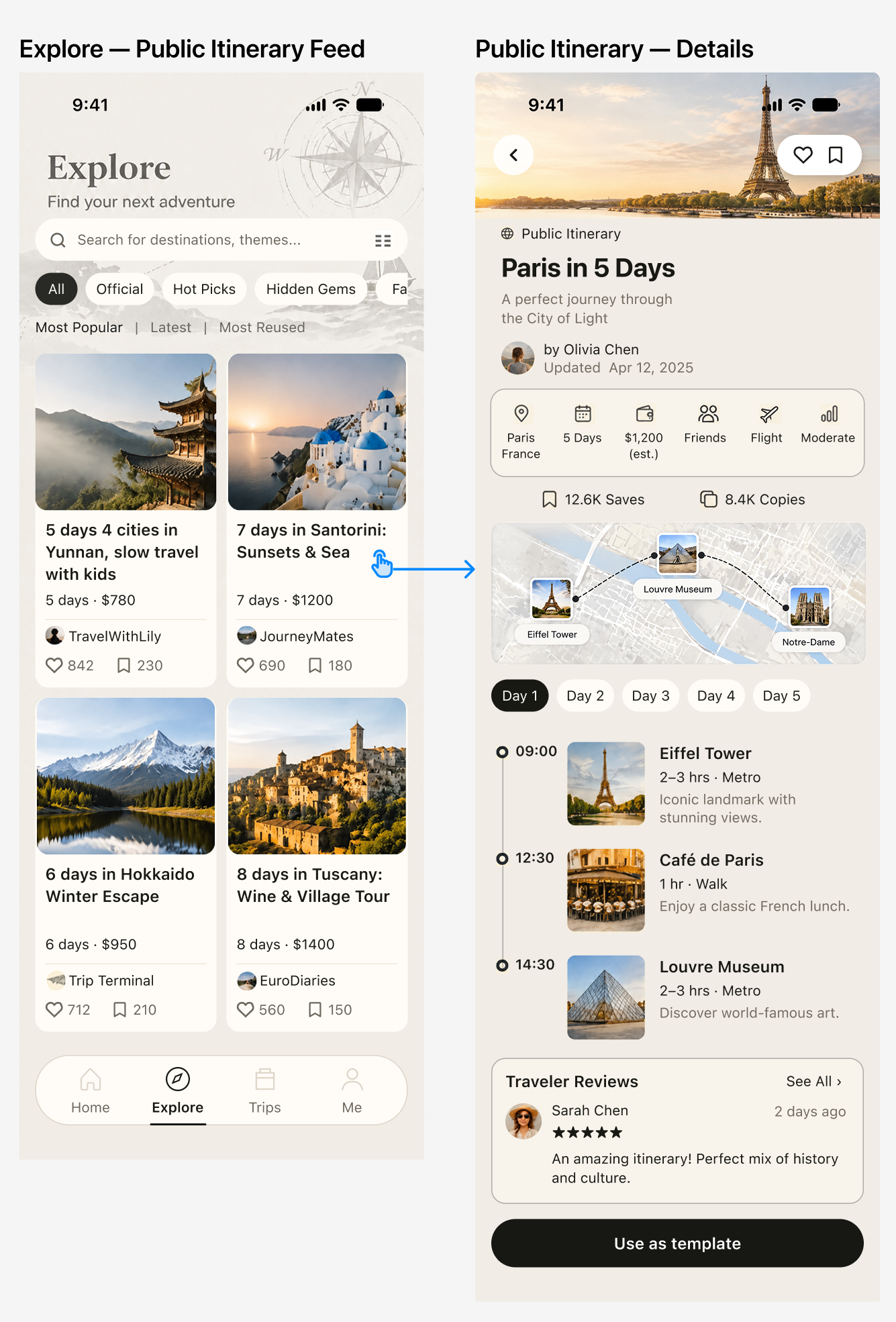
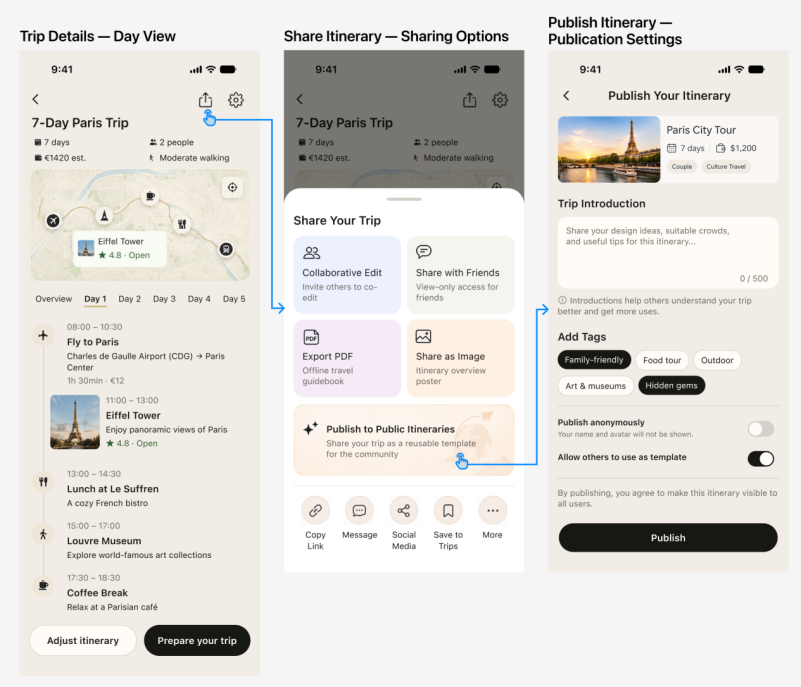
FLOWS 03 + 04 — DISCOVERY & SHARINGExplore public itineraries and reuse them as templates; publish with tags and permissions, collaborate privately, or export PDF and images.
08 — AI'S ROLE & SUMMARY
Where AI helped — and where it didn't
The core question — how AI turns fragmented planning into a personalized, trustworthy, actionable experience — is answered by designing a continuous journey rather than a one-shot generator. One limitation remains — validation stayed at prototype stage, and the feasibility of AI execution needs engineering verification.